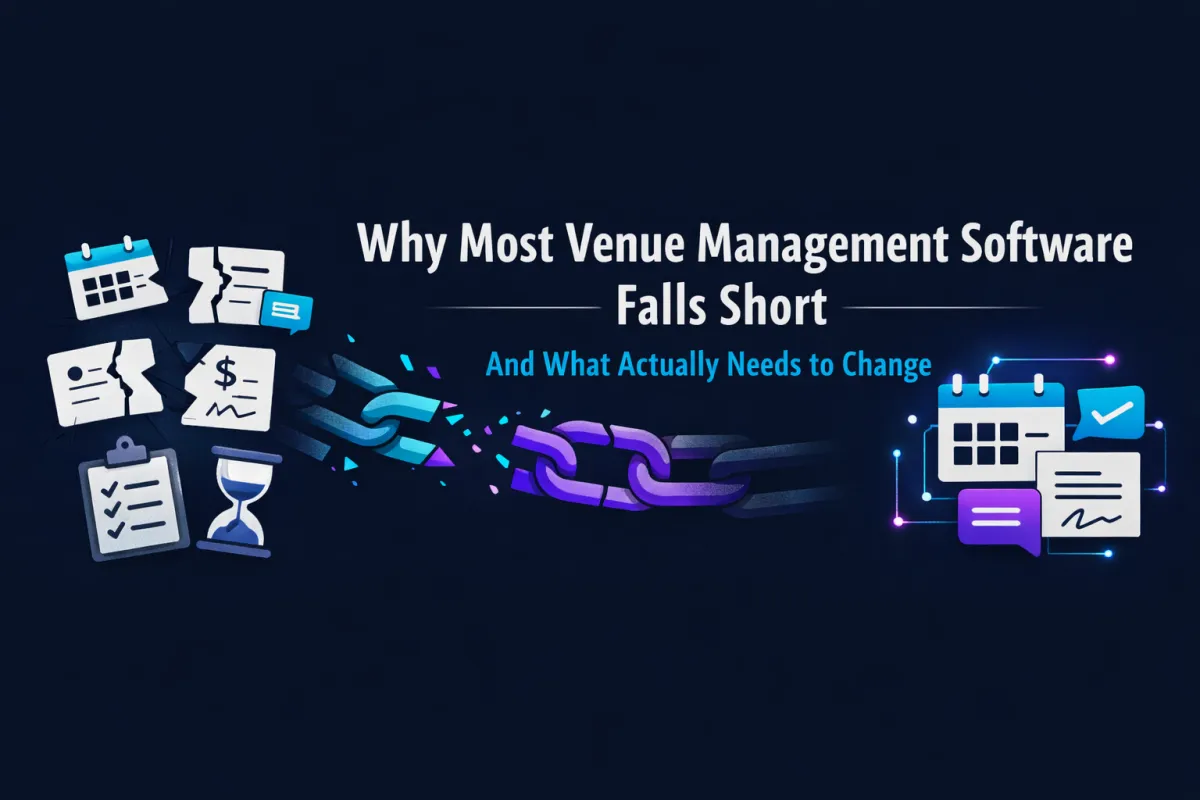
Why Most Venue Management Software Falls Short (And What Actually Needs to Change)
Most venue owners aren't struggling because they chose the wrong tool. They're struggling because no single tool was designed to manage the full operational lifecycle of an event venue, from first inquiry through final payment, marketing, and post-event follow-up.
After consulting directly with over 100 venues across the country, the pattern is consistent: venues aren't failing because of one bad platform. They're failing because five or six reasonable tools were never designed to work together.
Most venues aren't overpaying for one tool. They're paying the real cost in the gaps between five of them.
The difference between a venue that feels busy and one that's consistently booked often comes down to how tightly that system is connected.
This is the fragmentation problem. And it's costing venues bookings, revenue, and time in ways that are easy to misattribute to other causes.
What is the best venue management software?
The best venue management software connects CRM, calendar, contracts, payments, communication, and marketing into a single system designed specifically for venue operations, eliminating manual coordination between tools, like BrandWave for Events.
What venues are actually running, and where each tool stops
The typical venue technology stack includes a booking or CRM tool, a separate email marketing platform, a contract and invoicing system, a basic scheduling calendar, and sometimes an SMS tool.
Each serves a function. None of them connects to the others by design.
That last part is the problem.
Here’s how it plays out across the most common platforms.
HoneyBook
HoneyBook is a capable tool for freelancers and creative service businesses. It handles basic contracts, invoicing, and client communication cleanly. For solo operators or very small venues, it works.
Where it falls short for venues: it was built for single-service providers, not multi-room operations. There is no real calendar resource management, no SMS automation, no social media connectivity, and no ability to track equipment or space availability separately.
Venues outgrow it quickly.
Dubsado
Dubsado offers more workflow customization than HoneyBook and is popular with service businesses that need flexible automation. Venues often start here because of its contract and proposal tools.
The consistent feedback I hear from venues coming off Dubsado is that keeping track of leads, room availability, and follow-ups is still largely manual.
Dubsado was never designed around venue operations specifically. It’s a general service business tool that venues adapt, often with diminishing returns as volume increases.
Tripleseat
Tripleseat is purpose-built for hospitality and venue event management. It handles BEOs, event details, and internal operations better than most tools in this category.
What it doesn't do is marketing.
Email campaigns, SMS follow-up, social media, lead capture, and Google Business Profile management are all outside its scope. Venues using Tripleseat still need a separate marketing stack alongside it, which puts them right back in the fragmentation problem.
The common thread across all three: each tool solves a piece.
The venue owner becomes the connective tissue between all of them, manually moving information, tracking status, and filling the gaps the tools leave open.
Where venues quietly lose revenue
The cost of a fragmented venue management stack rarely shows up as one catastrophic failure. It accumulates in small operational delays that compound over time.
A lead comes in outside business hours and doesn’t receive a response until the next morning
A contract goes out two or three days after a tour
A deposit reminder slips
A final payment requires multiple follow-ups
A double-booking occurs because rooms aren’t tracked separately
None of these individually feel serious.
Together, they represent lost bookings, slower cash flow, and an operational load that grows with every event on the calendar.
This is usually the point where venue owners realize the issue isn’t effort, it’s structure.
What a connected venue management system actually looks like
A connected venue management system handles the complete event lifecycle in one place, from inquiry through final payment, with marketing, communication, and operations working from the same data.
In practice, that means:
Inquiries trigger immediate automated follow-up
Booking data flows directly into contract generation
Contract signature triggers the deposit invoice automatically
Payment reminders run based on the event timeline
Room availability, equipment, and conflicts are managed in one system
Email, SMS, and social media, including Google Business Profile, run from the same platform
You’re no longer managing every step.
You’re overseeing a system that runs.
That’s not a marginal efficiency improvement. It changes how many bookings a venue can handle without adding staff or hours.
How to evaluate venue management software: a practical checklist
Most comparisons focus on features in isolation.
A better question is whether the system works together, and whether it was designed for venue operations.
Before committing to any platform, ask:
Does the calendar manage individual rooms and spaces as separate bookable resources?
Can equipment be tracked and assigned within the booking system?
Are contracts populated automatically from booking data?
Is the payment structure built into the workflow?
Do email and SMS operate from the same platform?
Is social media scheduling, including Google Business Profile, integrated?
Can you see the financial status of every booking in one view?
Are reminders and follow-ups automated, not manual?
If most answers are no, the fragmentation cost is already affecting your business.
FAQ: Venue Management Software
What is venue management software?
Venue management software helps event venues manage bookings, contracts, payments, and marketing. The most effective systems connect all of these functions into one platform.
Is HoneyBook or Dubsado good for event venues?
They can work for simple setups, but they were built for service businesses, not multi-room venues, and often require additional tools.
What does Tripleseat not include?
Tripleseat focuses on operations but does not include email marketing, SMS automation, or social media, requiring a separate marketing stack.
How much does venue management software cost?
Most platforms range from $100 to $500 per month, but venues using multiple tools often spend more when combining systems.
The bottom line on venue management software
The best venue management software isn’t the one with the most features.
It’s the one that eliminates the most manual coordination.
For venues, that means a system built around the full event lifecycle, not a collection of tools that require constant oversight.
If you’re acting as the connective tissue between your tools, your system isn’t working the way it should.
Start here:
→ See how your current setup compares: www.meetbrandwave.com
→ Then book a demo if you want to see how this would work for your venue
Related reading
The Event Venue Calendar Problem Nobody Talks About
How to Stop Chasing Contracts and Payments at Your Event Venue