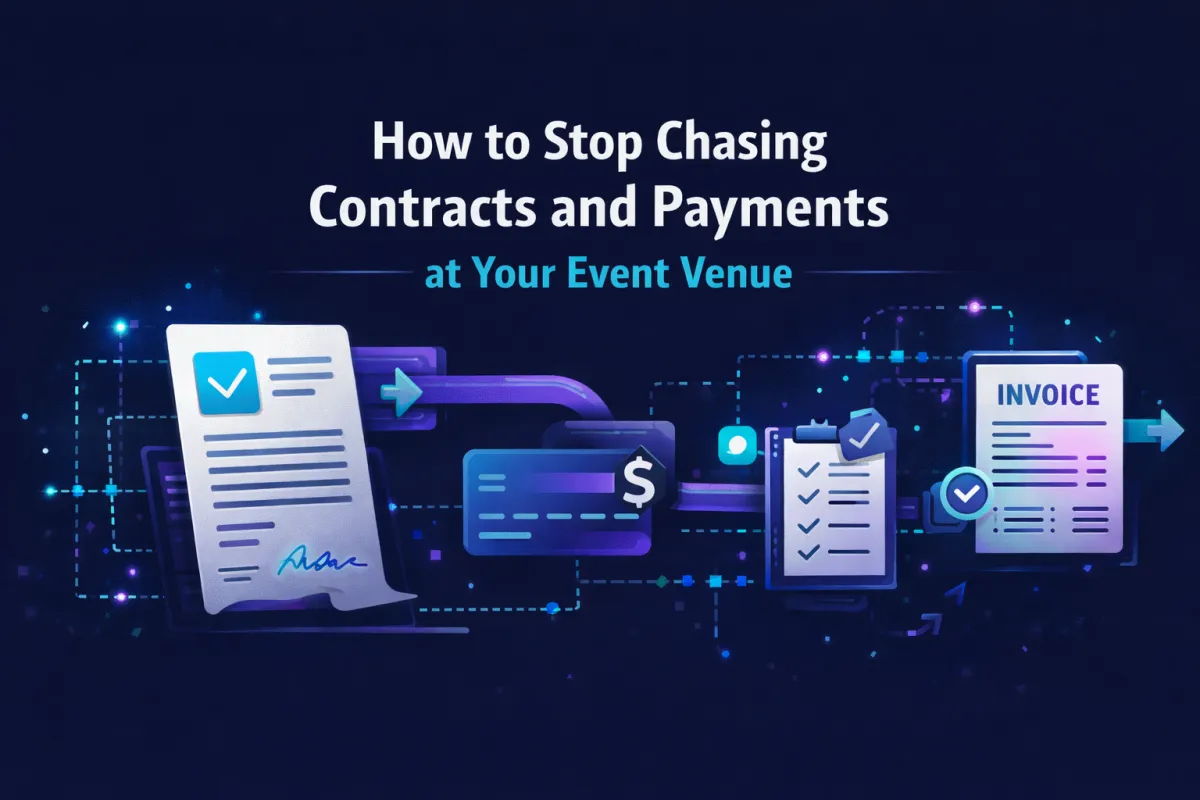
How to Stop Chasing Contracts and Payments at Your Event Venue
If you've ever sent a follow-up email asking whether someone received your contract, you already understand the problem — even if you've never named it.
Manual contracting isn't just inefficient. It introduces revenue risk at every step. The prospect who seemed interested and then went cold. The booking that felt solid but never quite converted. The client who signed with another venue while you were still finalizing the paperwork.
After working directly with over 100 venues as a consultant, I've seen this pattern often enough to say it plainly: the contracting and payment process is one of the highest-friction points in venue operations, and in most cases it's almost entirely fixable.
"The venues I've worked with don't lose bookings because of pricing. They lose them because the contract took three days to go out."
The difference between a venue that closes bookings consistently and one that loses them quietly often comes down to how tight this process is.
What is the best way for event venues to automate contracts and payments?
The best way for event venues to automate contracts and payments is to connect booking data, contract generation, signature collection, invoicing, and reminders into one workflow so each step triggers the next automatically using BrandWave for Events.
Why manual contracts and payments cost venues more than time
Manual contracting creates revenue risk at every step. The time between a confirmed booking and a signed contract is one of the highest-conversion windows in the sales process — and in a manual workflow, that window stays open longer than it needs to.
Speed-to-contract is a conversion variable most venues underestimate. But after seeing it play out across hundreds of consulting engagements, I can tell you: it matters more than almost anything else in the booking process.
The manual contracting cycle most venues are still running
The typical manual venue contracting process follows this sequence. Each step introduces a potential delay or failure point:
Booking confirmed verbally or by email
Contract created manually — usually by editing a previous version and updating the event-specific details
Contract sent — typically one to three days after the booking, sometimes longer
Follow-up email sent asking whether the contract was received
Signature returned — often after a second nudge
Deposit invoice created as a separate manual step and sent independently
Deposit tracked in a spreadsheet or CRM note
Final payment reminder sent manually — and sometimes not sent at all
This process doesn't fail dramatically. It fails quietly — in the prospect who chose another venue during the delay, the deposit that came in late, the final payment that required three emails to collect.
How does manual contracting affect venue revenue and cash flow?
This is the question most venue owners haven't stopped to calculate. The impact shows up across three areas.
Slower contracts mean lower conversion
Prospective clients evaluate multiple venues simultaneously. A venue that sends a contract the same day a booking is confirmed signals professionalism and urgency. A venue that takes three days gives the prospect time to reconsider — or to sign with a competitor who moved faster.
Most venues attribute lost bookings to price or fit. Speed-to-contract is the more common culprit.
Delayed deposits affect cash flow certainty
Every day between a confirmed booking and a collected deposit is a day that booking is technically unsecured. In a manual workflow, the gap between signature and deposit is often longer than necessary — because the invoice is a separate step that requires its own initiation.
At low volume this is manageable. At 20 or 30 simultaneous bookings, it becomes a cash flow problem.
Manual tracking creates compounding errors
When payment status lives in spreadsheets or notes rather than an automated system, reminders get missed, final payments are chased manually, and the administrative load scales with the number of active bookings. The business ends up needing more administrative capacity just to maintain the same booking volume.
How to automate venue contracts and payments: the connected workflow
Venue contract and payment automation works by connecting the booking, contract, invoice, and reminder steps into a single workflow — so that each stage triggers the next without manual intervention.
Here's what that looks like in practice.
Step 1: Contract generates from booking data
When a booking is confirmed, the contract is generated automatically using the event details already captured — date, space, guest count, package, pricing. No manual editing. No pulling up a previous version. No risk of the wrong date or wrong room in the paperwork.
This step alone eliminates the most common source of delay and error in the venue contracting process.
Step 2: Signature triggers the deposit invoice
Rather than creating and sending an invoice as a separate manual step, the deposit invoice is triggered automatically when the contract is signed. Signature first, payment second — in a sequence built into the system, not managed by a person.
This removes the gap between signing and invoicing that slows deposit collection in manual workflows.
Step 3: Payment timeline is set from the start
The full payment structure — deposit due at signing, balance due 30 days before the event — is part of the contract from the beginning. The client sees the timeline at signing. The system tracks it automatically. Reminders go out on schedule without anyone setting a calendar alert or remembering to follow up.
Step 4: Pipeline shows financial status across all active bookings
Instead of checking a spreadsheet, a connected system shows the financial status of every active booking in real time — contract sent, signed, deposit pending, deposit paid, balance due, fully paid. At a glance, across all events simultaneously.
For venues managing 20 or more bookings at once, this visibility is the difference between confident operations and constant catch-up.
What to look for in venue contract and payment automation
Not all venue platforms handle contracting and payment automation the same way. These are the capabilities that distinguish a genuinely automated workflow from a semi-manual one:
Do contracts generate automatically from booking data, or does each one require manual creation?
Is the deposit invoice triggered by the contract signature, or created as a separate step?
Is the full payment timeline — deposit and balance — structured into the workflow from the start?
Do payment reminders go out automatically based on the event date, or does someone have to send them?
Can you see the contract and payment status of every active booking in one view?
Is the entire lifecycle — booking through final payment — connected without manual handoffs between steps?
If most answers are "no" or "we handle that separately," the contracting process is carrying more overhead than it should.
Frequently asked questions about venue contract automation
How do venues automate contracts?
Venue contract automation works by connecting the booking system to the contract template so that when a booking is confirmed, a pre-populated contract is generated and sent automatically using the event details already captured. This eliminates manual editing and reduces the time between booking confirmation and contract delivery.
What is the best way to collect deposits from event clients?
The most effective approach ties the deposit invoice to the contract signature — so when the contract is signed, the deposit invoice is sent automatically. This closes the gap between signing and payment that slows collection in manual workflows.
Can BrandWave for Events automate venue contracts and invoices?
Yes. BrandWave for Events supports automated document generation, signature collection, and invoice triggering within workflows. BrandWave for Events is a venue-specific GoHighLevel configuration with pre-built contract-to-payment workflows designed for event venues — including deposit triggering on signature and automated balance reminders tied to the event date.
How long should it take to send a contract after an event is booked? In a well-automated venue system, a contract should go out the same day a booking is confirmed — ideally within minutes. In manual workflows, the average is one to three days. That gap is a meaningful conversion risk when prospects are evaluating multiple venues at the same time.
The compounding value of automated venue contracting
The shift from manual to automated venue contracting doesn't just save time. It changes the conversion and cash flow dynamics of the business. Faster contracts close more bookings. Faster deposits secure more dates. Automated reminders collect more payments without manual follow-up.
For a venue managing consistent event volume, the revenue impact of a tighter contracting workflow compounds over time — more so than almost any other single operational change.
BrandWave for Events includes pre-built contract-to-payment automation as part of every setup. Available from $100/month for DIY access, $1,500 for a fully configured system, or $3,000 for the premium consulting and implementation package.
If your contracting process still requires manual steps — if you're still editing contracts, creating invoices separately, or sending reminders yourself — that's fixable.
Start here:
→ See how your current setup compares: www.meetbrandwave.com
→ Then book a demo if you want to see the full contracting and payment workflow for your venue
Related reading: