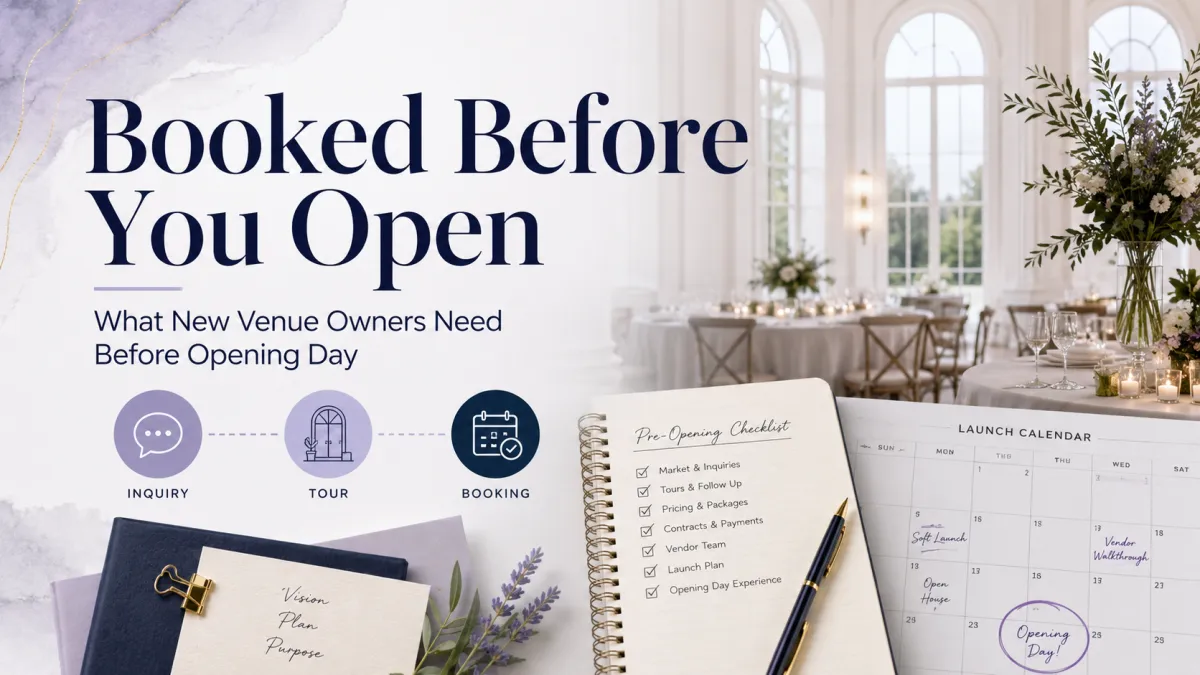
Booked Before You Open: What New Venue Owners Need Before Opening Day
Booked Before You Open: What New Venue Owners Need Before Opening Day
Opening a new venue is not just a construction project.
It is a business launch.
You may be choosing finishes, working with contractors, dealing with permits, planning landscaping, ordering tables, or trying to get the building ready for photos. All of that matters.
But there is another part of the launch that can sneak up on new venue owners:
People may start asking about your venue before you are fully open.
Someone may see your Coming Soon post. A planner may hear about the property. A couple may ask whether you are booking for next year. A corporate client may want to know when tours begin. A vendor may send someone your way.
That first inquiry is exciting. It is also the moment your business systems get tested.
Do you know where the inquiry goes?
Do you know what to say back?
Do you know whether the person is a good fit?
Do you know how to move them toward a tour, quote, proposal, contract, deposit, or waitlist?
If the answer is “not yet,” you are not behind. But you do need to build the business behind the venue before you start driving more attention to it.
That is the idea behind Booked Before You Open.
Your venue does not have to be fully finished before you begin building interest. But your inquiry path, pricing direction, booking process, and client communication need to be clear enough to handle real opportunities when they arrive.
Your Sales Clock Starts Before Opening Day
Many new venue owners think the sales process begins once the doors open.
In reality, your potential clients may be searching much earlier than that.
If someone is planning a wedding, corporate event, retreat, party, fundraiser, or private celebration, they may be looking at venues months in advance. Some will inquire before your building is complete. Some will want to tour while you are still finishing the space. Some will ask for pricing before your packages feel fully polished.
That can feel uncomfortable.
You may be tempted to say:
“I’ll figure out the sales process after construction.”
“I’ll build the system once we open.”
“I just need to get the website up first.”
“I’ll handle inquiries manually until we get busier.”
The problem is that early inquiries are not practice leads. They are real opportunities.
If someone reaches out and the response is slow, vague, scattered, or confusing, they may move on to another venue. They may not tell you why. They may simply book somewhere that felt more prepared.
That is why pre-opening venue owners need more than a pretty property.
They need a clear path from interest to booking.
What New Venue Owners Usually Focus On First
Most new venue owners are understandably focused on the physical venue.
That often includes:
Construction or renovation
Permits and inspections
Parking
Restrooms
Fire safety
Landscaping
Furnishings
Tables, chairs, and rentals
Lighting
Photos and renderings
Website copy
Social media announcements
Those pieces matter. You cannot ignore them.
But they are not the full business.
The venue may look beautiful, but if you do not have a way to capture leads, respond quickly, track interest, schedule tours, send pricing, collect deposits, and follow up, you can still lose bookings.
The question is not just:
“When will the venue be ready?”
The better question is:
“When someone is ready to inquire, are we ready to guide them?”
The Six Areas to Put in Place Before Opening Day
Before you begin marketing heavily or trying to fill your calendar, focus on these six areas.
They do not all have to be perfect. But they do need to be defined enough that you are not making every decision from scratch while a real client is waiting.
1. Venue Direction and Opening Priorities
Before you can sell your venue, you need to know what you are actually building.
That sounds obvious, but many new venue owners are still making key business decisions while they are already talking to potential clients.
You should be able to clearly explain:
What kind of venue you are creating
What types of events you want to host
What guest capacity you can support
Whether you are rental-only, more inclusive, or somewhere in between
What spaces are available
What makes your venue different
What kind of client is the best fit
What is ready now and what is still in progress
This does not mean you need a perfect brand strategy before anyone can ask about your venue.
It does mean you need enough clarity to avoid vague answers.
If someone asks, “What kind of events do you host?” or “What is included?” or “Are you available next fall?” you should not be scrambling for a basic answer.
Your venue direction affects the rest of the business.
It shapes your pricing, packages, marketing, inquiry questions, tour experience, contracts, payment process, and vendor partnerships.
2. Pricing and Packages
Pricing is one of the most stressful parts of opening a new venue.
You may not have market feedback yet. You may not have reviews. You may not know how people will respond. You may be worried about pricing too high and getting silence, or pricing too low and hurting your margins for years.
But waiting too long to think about pricing creates its own problems.
If inquiries begin before your packages are clear, you may end up answering every lead differently. You may send inconsistent quotes. You may underprice early dates just to get bookings. You may forget to account for labor, cleaning, utilities, payment fees, setup time, or owner compensation.
At minimum, define:
Your core rental or package options
What is included
What is not included
Available add-ons
Access times
Capacity limits
Setup and cleanup responsibilities
Payment requirements
Your minimum profitable price
Whether you will publish pricing, send ranges, or use a guided quote process
Your pricing and packages do not need to be frozen forever.
They do need to be clear enough that you can talk about them with confidence.
A potential client does not need you to have every future detail figured out. They do need to feel that you understand your own offer.
3. Inquiry Intake
An inquiry is not just a message.
It is the beginning of your sales process.
Before you drive more traffic to your website, social channels, ads, or venue listings, decide where inquiries should go and what happens next.
Your inquiry process should answer:
Where does someone inquire?
What form or page do they use?
What information do you collect?
Who gets notified?
What response goes out first?
How quickly do you respond?
Where is the lead tracked?
What happens if they do not reply?
What is the next step?
A new inquiry should not disappear into a personal inbox, Instagram DM, text thread, sticky note, or spreadsheet.
That may work when one person is curious. It does not work when you are trying to turn real interest into booked dates.
A strong inquiry intake process helps you capture the right information from the start.
That might include:
Name and contact information
Event type
Preferred date or season
Estimated guest count
Ceremony or event needs
Package interest
Tour interest
How they found you
Whether they want pricing, a tour, or more information
The goal is not to interrogate people.
The goal is to guide them.
The better your inquiry intake, the easier it becomes to route someone toward the right next step.
4. Pre-Opening Lead Capture
You do not need to wait until opening day to build interest.
In fact, if your goal is to open with bookings on the calendar, you should not wait.
A pre-opening lead capture system helps you collect and organize interest while the venue is still being built, renovated, or prepared.
This may include:
A Coming Soon page
A pre-opening interest form
A preferred-date waitlist
A tour request form
A launch announcement list
A preview event registration form
A planner or vendor interest list
The key is to collect more than just an email address.
You want to know who is serious, what they are planning, and when they may want to book.
Useful fields might include:
Event type
Preferred date or season
Estimated guest count
Tour interest
Package interest
Planning timeline
How they heard about the venue
This allows you to segment your early leads.
Someone planning an event next spring is different from someone casually following your renovation updates. Someone asking about a date and guest count is different from someone who just wants opening announcements.
Both may be useful. But they should not be treated the same.
5. Booking and Payment Path
Interest is not the same as a booking.
A date is not officially booked just because someone said they loved the venue.
Before you start taking serious inquiries, define what moves someone from interested to confirmed.
Your booking process should answer:
What makes a date available?
Do you offer temporary date holds?
How long does a hold last?
When is a quote or proposal sent?
When is the contract sent?
What deposit is required?
When is the booking officially confirmed?
When is the final balance due?
What reminders go out?
What happens if a contract is not signed?
What happens if a deposit is not paid?
What happens if someone cancels or reschedules?
These decisions are easier to make before you are dealing with a real client, a real date, and real money.
They also protect the client experience.
When the process is clear, the client knows what to expect. You know what to track. Your team knows what happens next.
That clarity matters even more for a new venue, because clients are often looking for reasons to feel confident.
A clean booking path can make a new venue feel organized, trustworthy, and ready.
6. Marketing and Follow-Up
Marketing your venue should not start with “post more” or “run ads.”
It should start with a clear path.
Before you spend money driving attention to your venue, make sure you know where that attention is going.
At minimum, your early marketing foundation should include:
A simple website or Coming Soon page
A clear inquiry or waitlist form
A Google Business Profile plan
Social profiles that direct people to the next step
Progress photos, renderings, or story-based content
A basic content plan
A follow-up process for new leads
Lead source tracking
This matters because marketing without follow-up creates leakage.
You may get attention, but not bookings.
You may get clicks, but not conversations.
You may get inquiries, but lose track of them.
A new venue’s early marketing should help people find you, trust you, and take the next step.
That next step may be joining the waitlist, requesting pricing, booking a preview tour, scheduling a call, or asking for more information.
The point is that every marketing channel should connect to a clear action.
What Happens If These Pieces Are Missing?
When the business foundation is not ready, the problems usually show up in small ways first.
A lead waits too long for a response.
A pricing question gets answered differently each time.
Someone asks for a tour, but there is no process to schedule it.
A potential client ghosts, and no one follows up.
A contract is sent, but no one notices it was never signed.
A date is assumed to be booked, but the deposit was never paid.
A new venue owner thinks they are “not getting good leads,” when the real issue is that the lead path is unclear.
These are fixable problems.
But they are easier to fix before the volume increases.
Your Venue Does Not Need to Be Perfect. Your Next Step Does.
One of the biggest misconceptions about pre-opening marketing is that everything has to be finished before you can begin.
That is not true.
You can build interest while the venue is still in progress.
You can collect leads before every photo is perfect.
You can start conversations before the building is fully complete.
You can book tours before every detail is done, if you are honest and prepared.
But you need a next-step process.
That is what helps potential clients feel guided instead of uncertain.
It also helps you feel less scattered as the owner.
You are not trying to manually remember every inquiry, every date, every follow-up, every pricing request, every tour, and every contract.
You are building a business process that can support the venue you are working so hard to open.
The New Venue Launch Checklist
To help you evaluate what is ready and what still needs attention, we created:
Booked Before You Open: The New Venue Launch Checklist
It walks through the key pieces new and pre-opening venue owners should have in place before marketing, touring, and booking.
The checklist covers:
Venue direction and opening priorities
Pricing and packages
Inquiry intake
First inquiry response
Pre-opening lead capture
Booking and payment path
Tour scheduling and follow-up
Early marketing foundations
Lead source tracking
Review and referral planning
You can use it to mark what is ready, what needs attention, and what has not been started yet.
Final Takeaway
Opening a venue is a major project.
But the venue itself is only one part of what you are building.
You are also building the business that will book it.
Before you market harder, make sure you know what happens when someone reaches out.
Before you offer tours, know what information you need and what comes next.
Before you send pricing, understand your packages and boundaries.
Before you call a date booked, define the contract, deposit, and payment process.
Before opening day, build the path that turns interest into confirmed bookings.
That is how you move from a venue under construction to a business ready to book.
Ready to See What Your Venue Still Needs?
Download Booked Before You Open: The New Venue Launch Checklist and identify which parts of your venue launch foundation are ready, incomplete, or not started.
Then watch the Booked Before You Open video series for practical guidance on inquiries, follow-up, waitlists, booking workflows, tours, and early venue marketing.
You are building the venue. Now build the business that will book it.